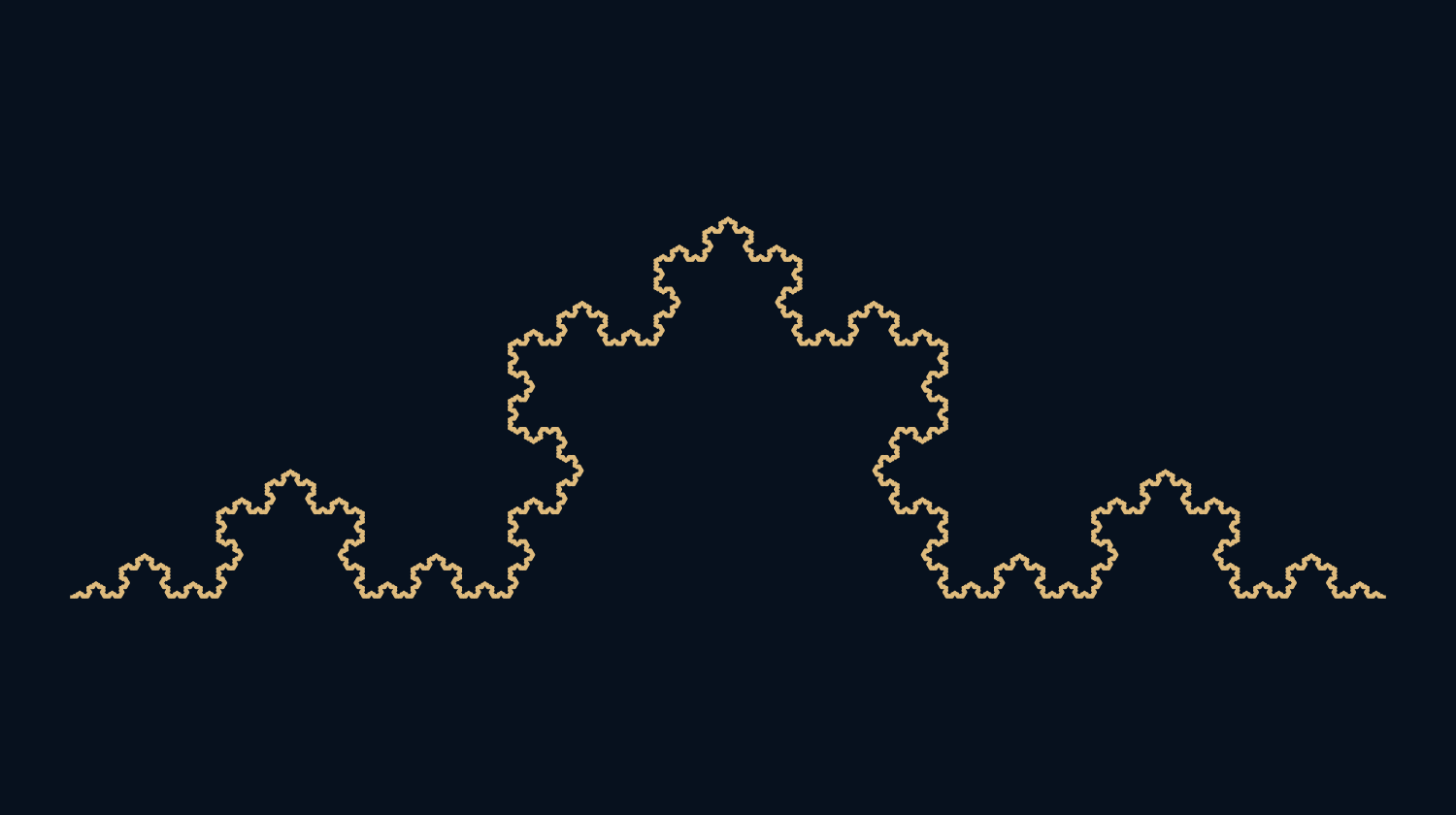
Can a boundary get longer without its endpoints moving?
Replace a straight segment with four smaller segments that take a triangular detour. Repeat the rule on every new segment. The endpoints stay where they were, but the route between them keeps gaining length. This is the Koch construction, a precise mathematical example that helps explain why measuring a complicated boundary needs a stated scale.
A length needs a ruler and a stopping rule.
One segment becomes four
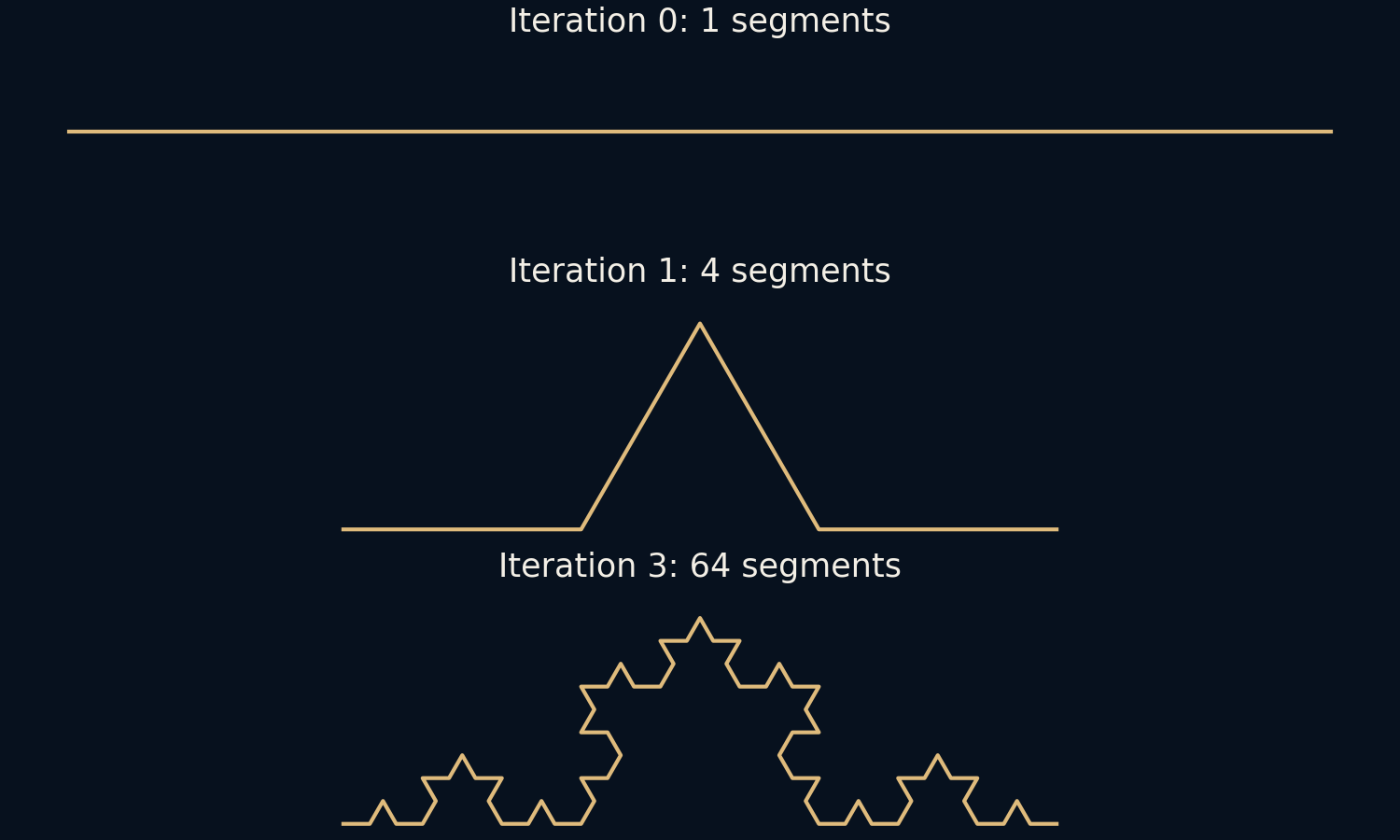
Begin with a line of length one. Divide it into thirds. Replace the middle third with the two other sides of an outward equilateral triangle. The result contains four pieces, each one third of the original length. Its total length is therefore four thirds, even though the endpoints are unchanged.
Apply exactly the same operation to every piece. After the second iteration, sixteen segments have total length sixteen ninths. No randomness is involved. Every corner follows from the previous segment’s direction and a fixed sixty-degree rotation. The visual intricacy is produced by repeated application of one short rule.
The arithmetic grows faster than the drawing suggests
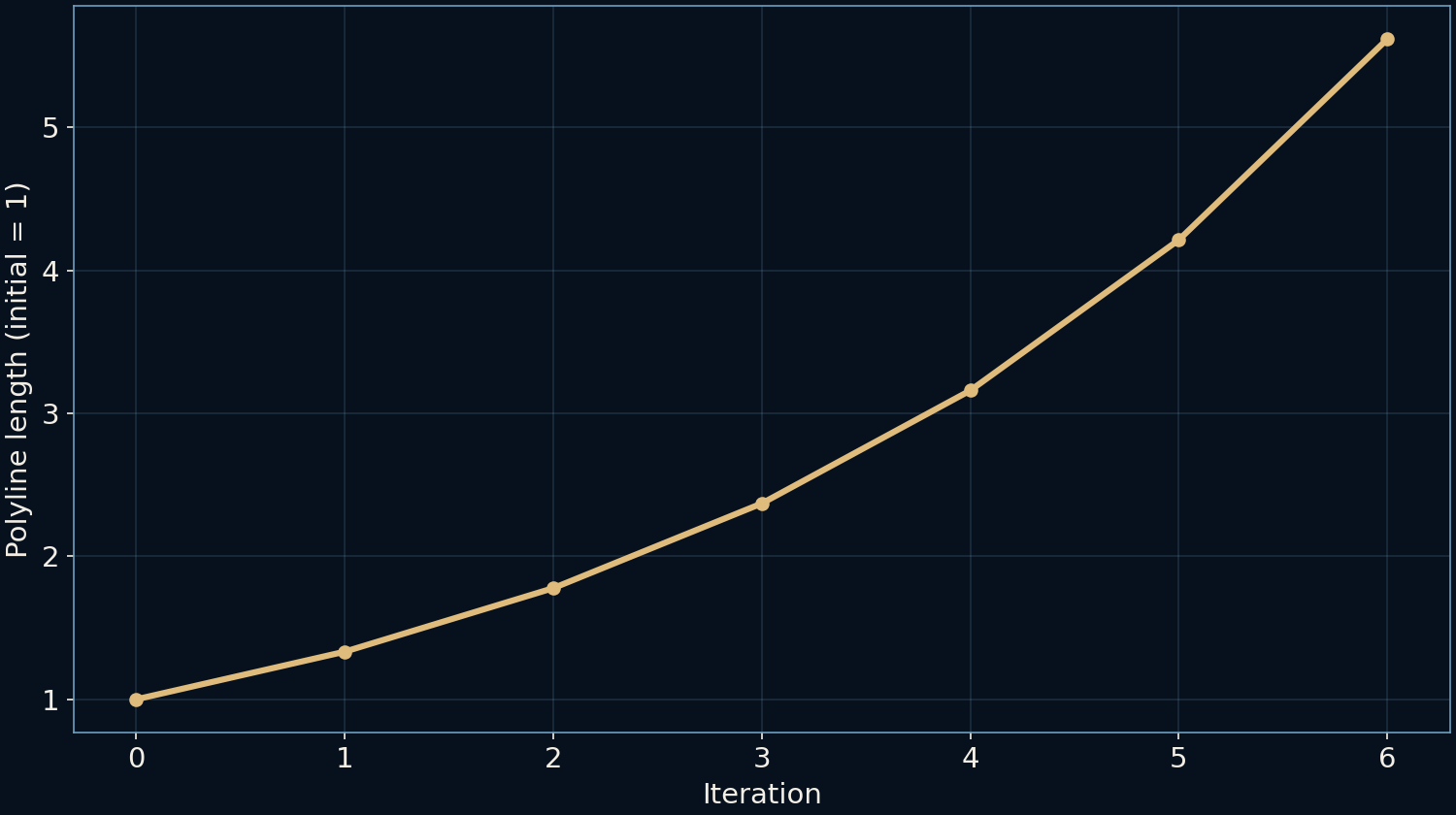
After n iterations there are four to the power n segments, each three to the power minus n units long. Multiplying those quantities gives total length (4/3) to the power n. At iteration six, there are 4,096 segments and the length is about 5.62 times the original.
Each individual piece is then only 1/729 of the starting length. The outline still fits within a modest region, so its growing length can feel surprising. The extra distance is stored in many small turns rather than in a large change to the endpoints or overall width. The plot also separates the growth of segment count from the growth of length. Count multiplies by four at each step, while length multiplies only by four thirds because every new segment is shorter. More pieces and more distance are related, but they are not interchangeable measures.
Zooming creates a familiar shape
A portion of the ideal curve repeats the same construction at a smaller scale. This exact self-similarity distinguishes the mathematical object from a merely jagged line. In the limit of infinitely many iterations, the length grows without bound while the endpoints remain fixed.
The article’s pictures are finite polylines, not that infinite limit. Their lengths are finite and directly computable. A screen cannot display infinitely small turns, and the script stops after six iterations. Keeping the finite drawing separate from the limiting mathematical statement prevents a dramatic phrase from turning into a misleading measurement.
A coastline is an analogy, not this equation
Natural shorelines have bays, rocks and small irregularities that become relevant at different scales. A finer measuring method may include more of those turns and report a longer boundary. That is the useful connection to the Koch curve: changing the measurement scale can change the answer.
A real coastline is not an exact Koch construction. Tides, erosion, sediment, map conventions and the definition of the shore all matter. Natural detail also has physical limits. Our calculation cannot assign a country’s coastline length or prove that any particular shore has an infinite length.
The display has its own ruler
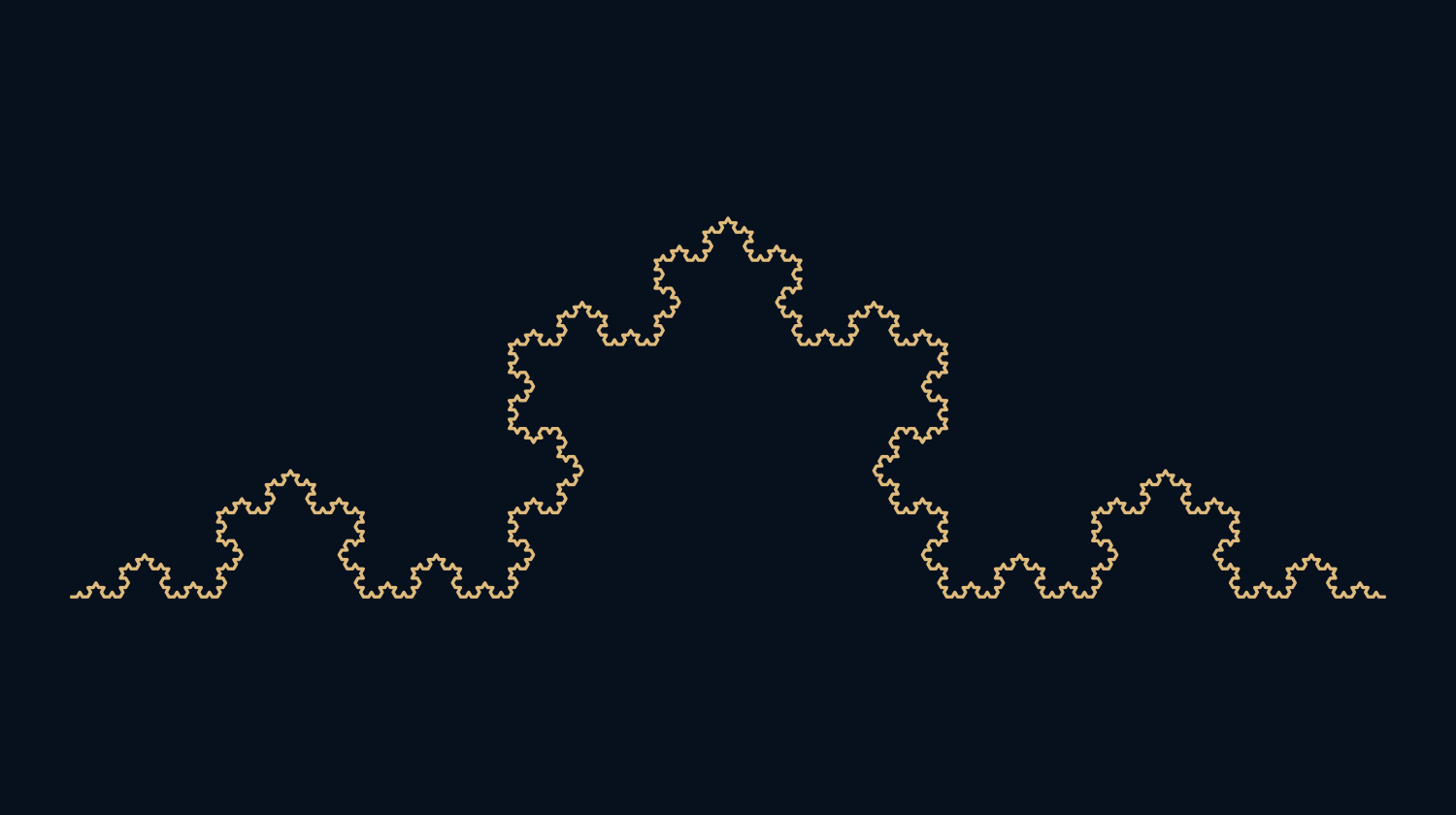
When thousands of short segments are squeezed into a small picture, several can fall inside a single pixel. Rasterization and antialiasing summarize them. Enlarging the same low-resolution image only enlarges that summary; it does not reveal turns that were never preserved in its pixels.
A vector description can generate the geometry again at a different display scale, but even that description here has a finite iteration count. To show more construction detail, the model must actually add another iteration. The distinction between zooming a representation and generating additional geometry is easy to overlook.
Ask which length is useful
For a walking route, a map border or a manufactured edge, the relevant scale depends on the job. Tiny indentations that matter for material contact may be irrelevant to travel. A useful reported length should identify the geometry and the measurement resolution rather than pretending every possible ruler must agree.
The Koch example does not make measurement futile. It makes the assumptions visible. Once the stopping rule is specified, every finite iteration has an unambiguous length that two implementations can check. The uncertainty comes from asking a scale-dependent question while leaving the scale unsaid.
Further reading
Wolfram MathWorld: Koch snowflake ↗Encyclopaedia Britannica: fractal ↗Original documentation and useful background.