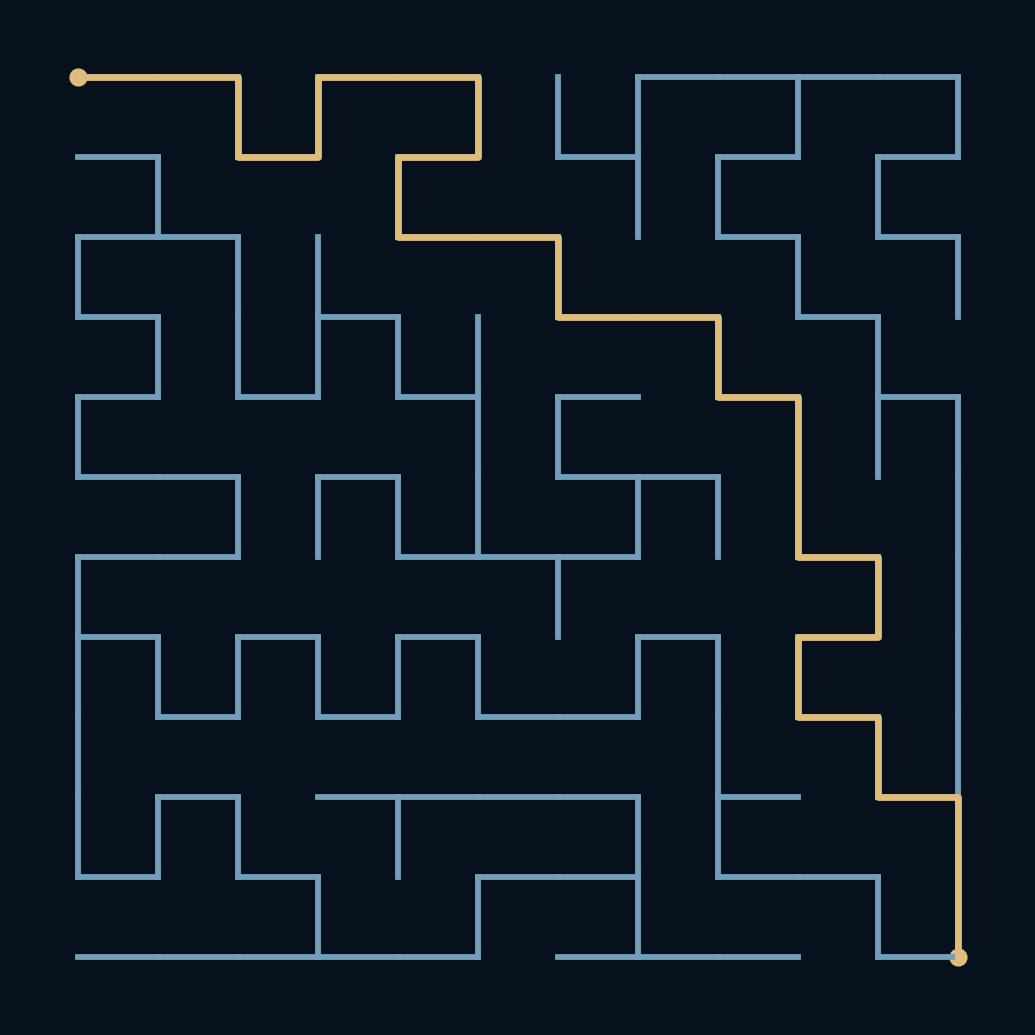
A corridor can turn five times and still be only one connection.
Looking at a maze, the eye follows walls. A computer can ignore most of them. Give every cell a name, record which neighbouring cells have a passage between them, and the picture becomes a graph. This change of viewpoint is useful far beyond puzzles. The same basic structure can describe rooms, folders, circuit connections or dependencies between jobs. The difficult-looking picture is often the friendly part: once the connections are written down, there is something precise to check.
The walls create the puzzle. The connections make it solvable.
Start with rooms, then decide which doors exist
Imagine an empty rectangular grid. Each cell is a tiny room, and each shared edge is a possible doorway. At the beginning, keep every doorway shut. Opening selected doors creates corridors. In the graph version, the rooms are vertices and open doorways are edges. A turn in a corridor matters to the drawing but does not add a new kind of relationship. You can redraw the rooms in completely different positions while preserving which ones connect.
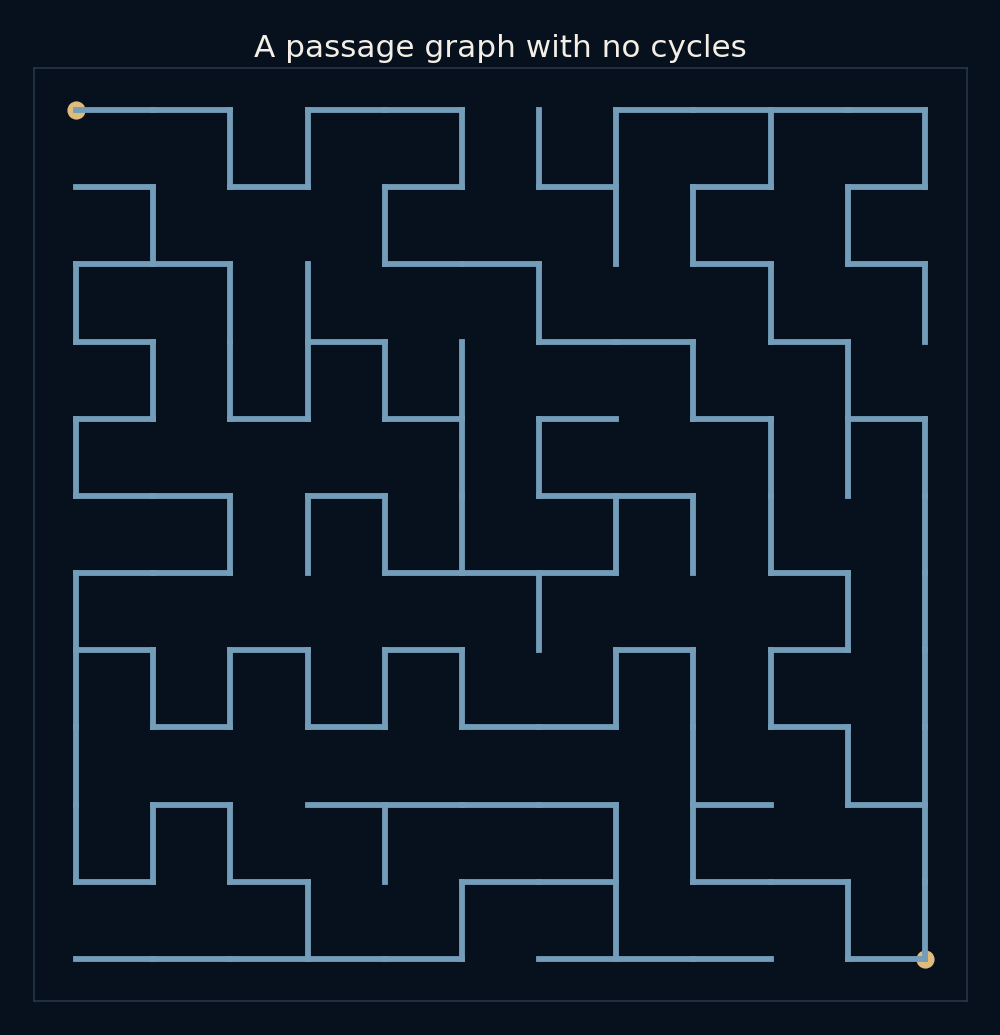
That distinction is handy when checking a maze. Whether the walls look elegant is a visual judgement. Whether the exit is reachable is a connectivity question. Mixing the two makes both jobs harder. We first build and inspect the passage graph. Here the illustrations display the connections directly as lines rather than adding a drawing of the walls.
A tree gives every pair of rooms one simple path
A connected graph with no cycle is called a tree. If the maze passages form a tree, any two cells have exactly one simple path between them. Simple means the path does not revisit a cell. A visitor can still get lost, retrace steps and wander into dead ends; the uniqueness describes the underlying solution, not the experience of walking it.
For a tree with N cells there are N minus one passages. The edge count alone is insufficient, however. A disconnected collection could have that many edges and still contain a loop somewhere. Our checks combine the count with a traversal that reaches every cell. Together, those properties establish a tree for this undirected grid graph. This generated 12 × 12 example has 144 cells and 143 passages.
Exploration can build the corridors
The generator explores unvisited neighbours and opens a passage when it enters a new cell. When it reaches a place with no unvisited neighbour, it returns along its earlier route until it can continue. This is the idea behind depth-first backtracking. Each new cell joins the already connected part through one doorway, so the growing passage graph stays connected without creating a cycle.
Random neighbour choices make different layouts. A fixed seed makes the particular choice sequence reproducible. It does not make all possible mazes equally likely. This generator tends to produce a recognisable corridor texture, and another algorithm can give a very different-looking maze while satisfying exactly the same tree properties.
The solver does not need a sense of direction
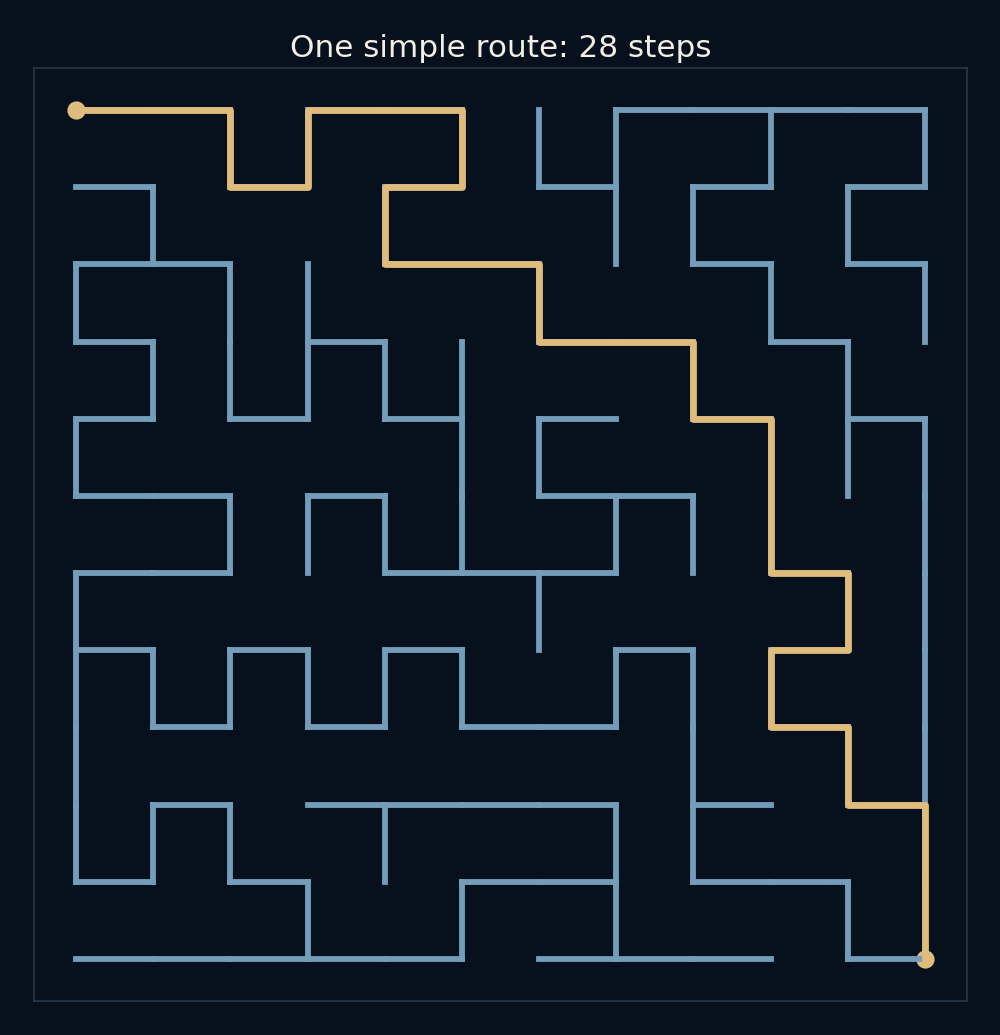
Breadth-first search explores cells in layers: first the start, then cells one passage away, then two passages away, and so on. Remembering each newly reached cell's predecessor lets us reconstruct a route when the exit is found. With equal-cost passages, this finds a route with the fewest edges. In a tree there is only one simple route to find anyway.
The illustration overlays the computed 28-edge route on the passage graph, from cell 0 at the upper left to cell 143 at the lower right. Each consecutive pair must share an actual open doorway; being adjacent in the picture is not enough. A plausible gold line that crosses between unconnected cells would be a bug, even if the entrance and exit looked correct.
One extra doorway changes the kind of puzzle
Open a wall between two cells that are already connected through the tree. The new doorway creates a cycle. There are now two simple ways around that loop, and some journeys gain an alternative. This is a small edit with a structural consequence: the maze stops being a perfect maze in the usual graph-theoretic sense.
It is tempting to call the new maze easier, but that requires a definition. An extra connection might shorten the solution while making the choices less obvious to a human. Dead-end count, shortest-path length and the number of junctions describe different aspects. None of them alone measures how satisfying a person will find the puzzle.
A prettier picture is not a stronger guarantee
The local test treats cells as equally accessible and passages as equally costly. It does not model a person, a wheelchair, a locked door or a corridor that takes longer to cross. Real navigation needs those details and often needs a weighted graph instead. The maze is a small, clean example in which the assumptions are visible.
The part worth borrowing is the order of work: define the relationships, check the properties, then draw the explanation. A polished diagram can hide a disconnected room remarkably well. A simple traversal will not admire the layout. It will merely tell you that one room was never reached, which is exactly the kind of impolite honesty a useful test should have.
Further reading
NetworkX: trees and acyclic connectivity ↗NetworkX: breadth-first traversal ↗Original documentation and useful background.