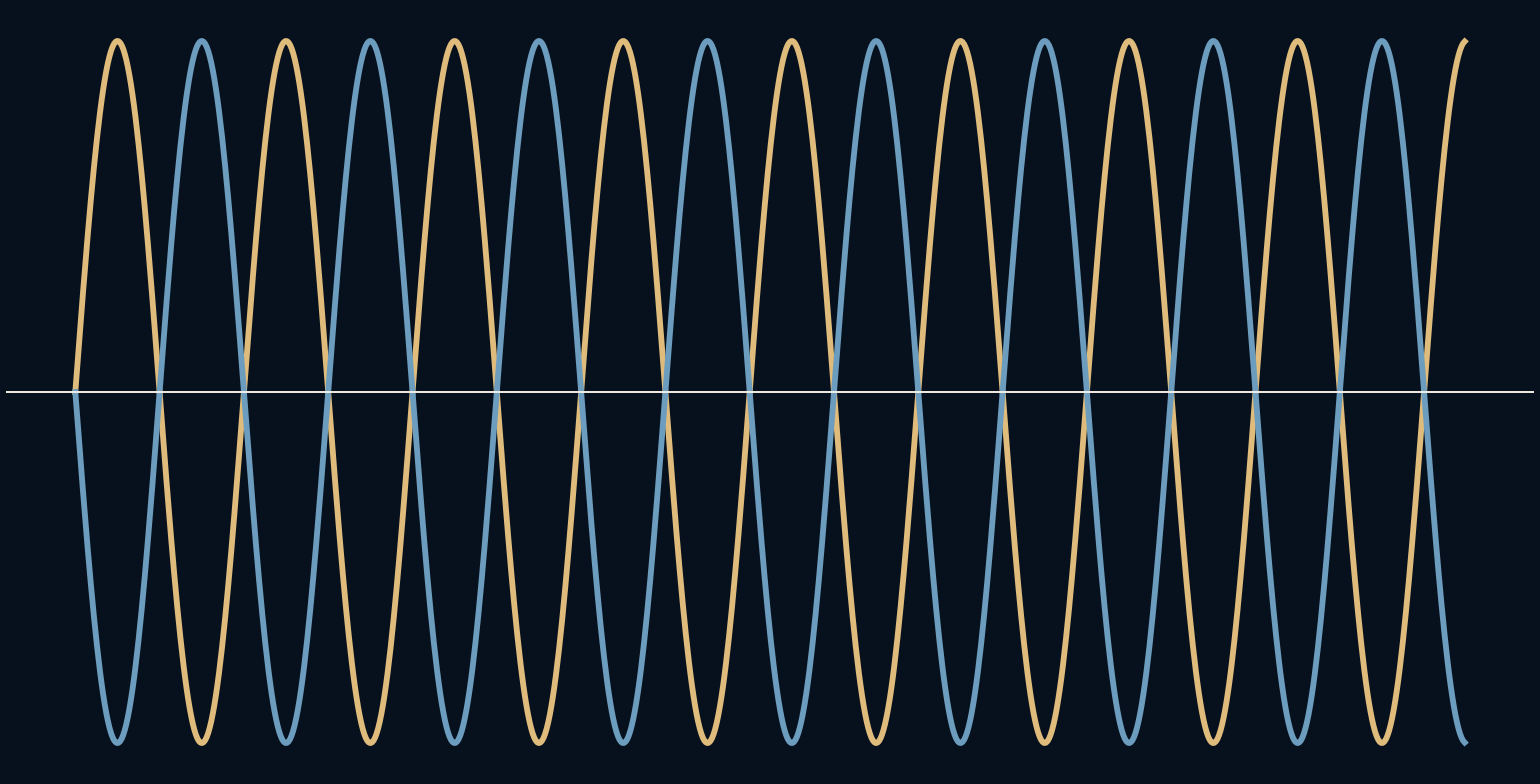
How can another sound make the first one quieter?
Imagine a pressure change that pushes air slightly above its resting pressure. At the same place and moment, a second disturbance pushes by the same amount in the opposite direction. Their sum is zero. The idea behind cancellation is simple enough to draw, but the drawing also reveals why real silence is much harder to arrange.
Cancellation is an agreement about timing.
The air keeps only the sum
For small disturbances, sound pressures approximately add. A microphone at a particular point records their combined effect, not a separate value for each speaker. A positive pressure excursion and an equally large negative excursion can therefore leave no net pressure variation at that instant. The waves need not disappear everywhere for this to happen locally.
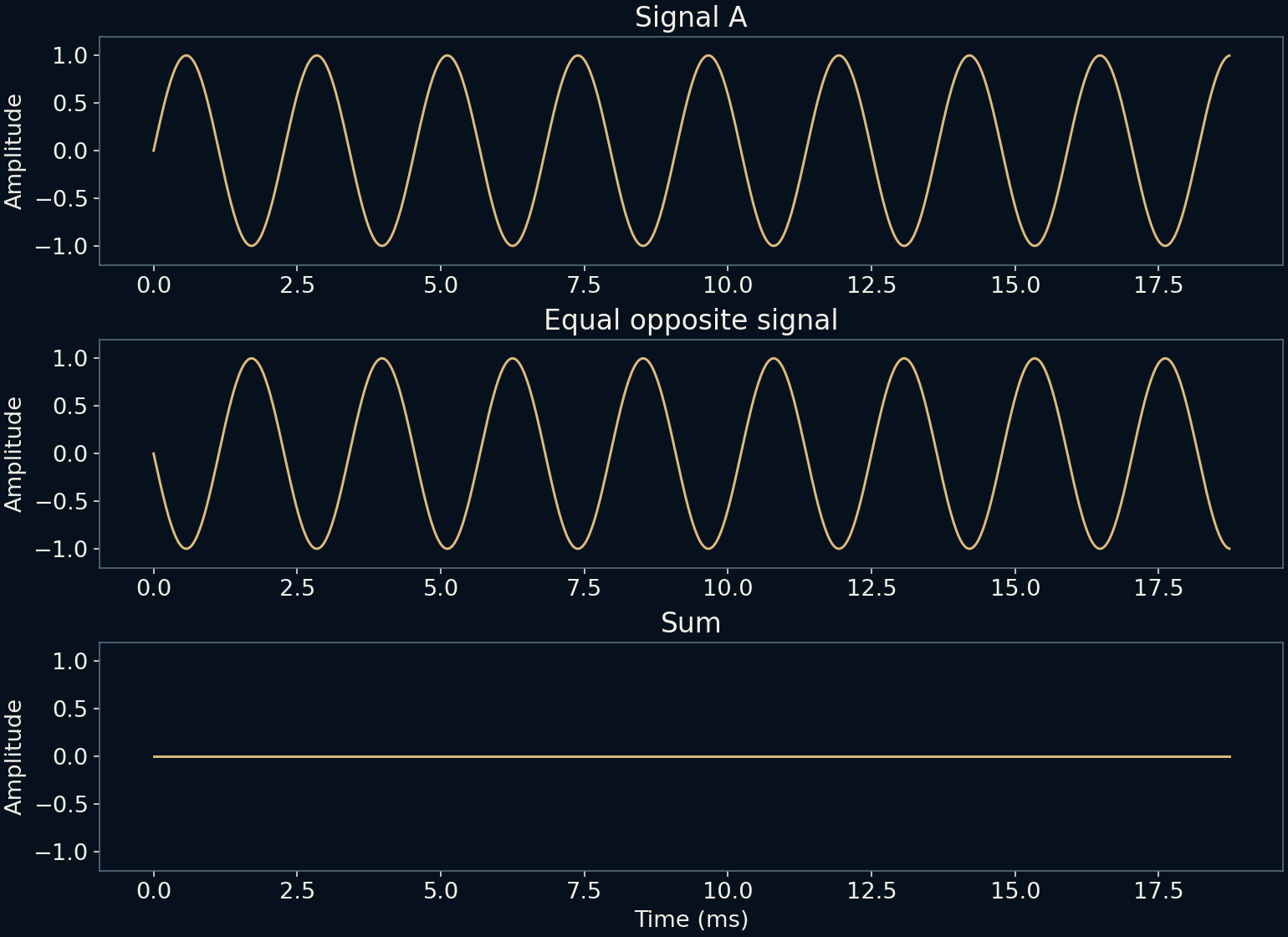
Our calculation begins with a 440 Hz sine wave of amplitude one. The second has the same frequency and amplitude, shifted by half a cycle, or 180 degrees. At every sample, one rises exactly as the other falls. Adding those two arrays produces a line essentially indistinguishable from zero.
Half a cycle is a very specific delay
At 440 Hz, one cycle lasts about 2.27 milliseconds. Half of it is roughly 1.14 milliseconds. That same delay would not be half a cycle for every other frequency. A complicated sound contains many changing components, so matching a single sine wave is a deliberately generous starting point.
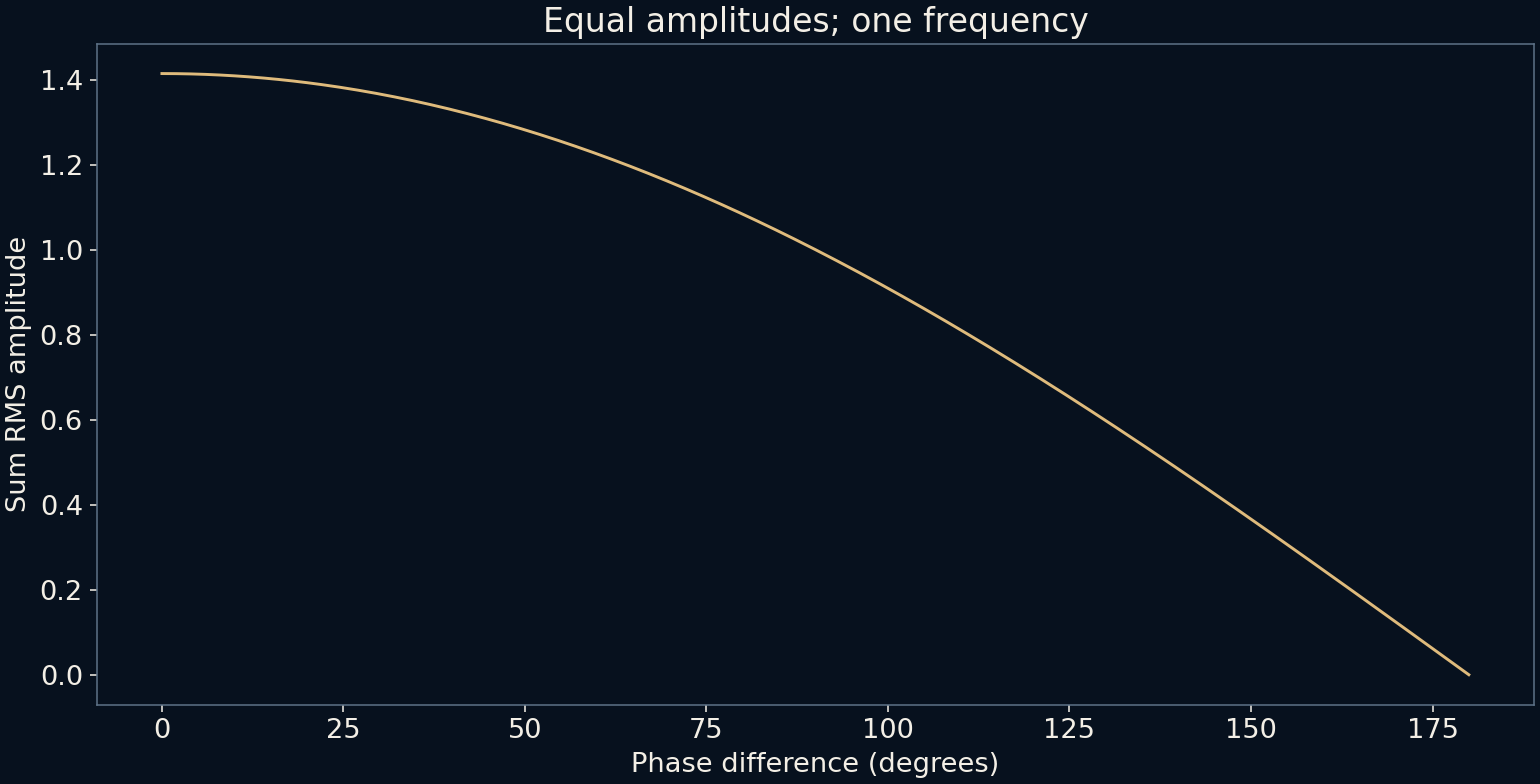
The phase plot keeps both amplitudes fixed and changes only their relative timing. In phase, the waves reinforce and double the peak amplitude. At 180 degrees they cancel. Between those extremes, the sum remains another sine wave with an amplitude determined by the phase difference. Adding a second signal is therefore not automatically a reduction.
A small mismatch leaves something behind
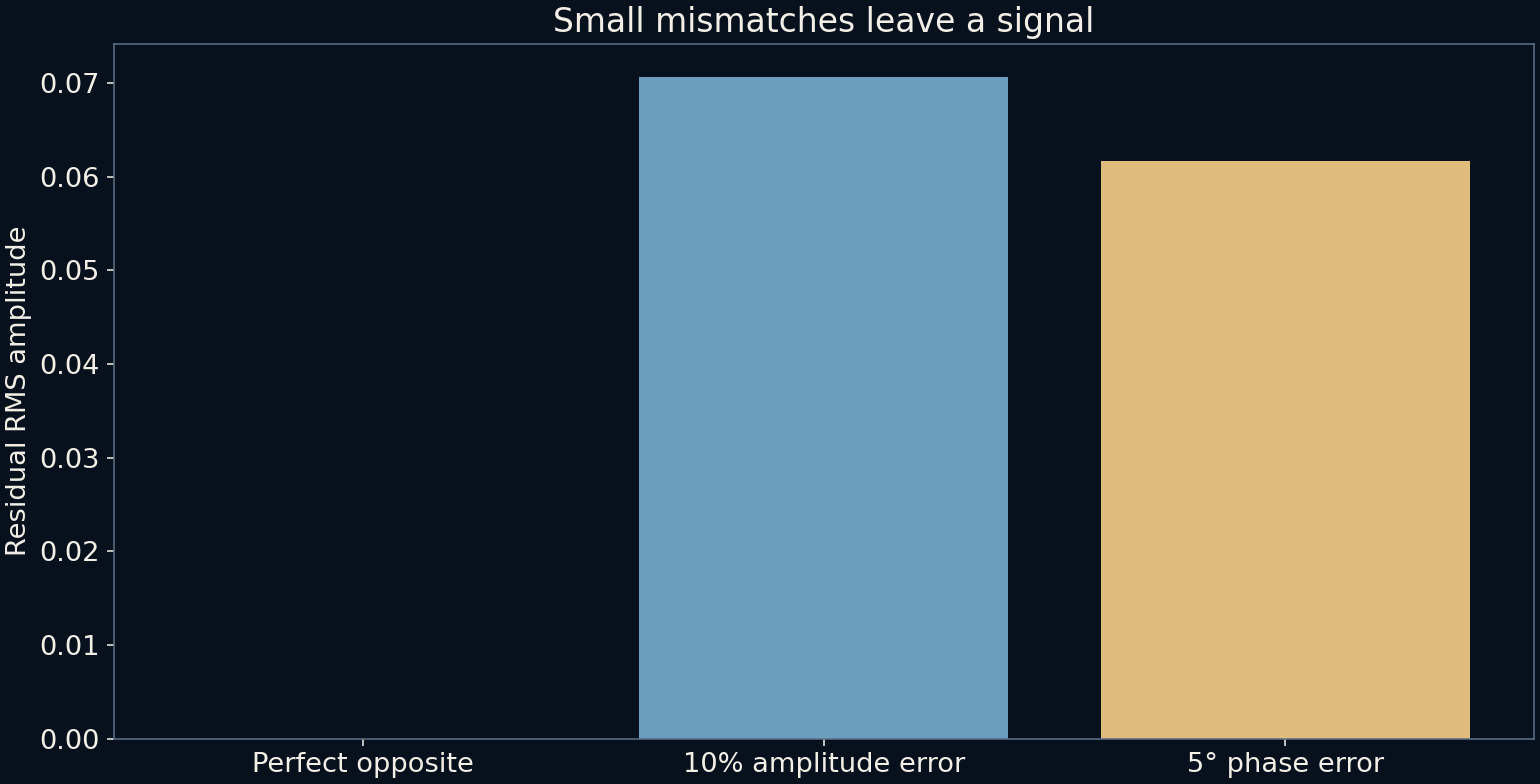
To calculate the root-mean-square, or RMS, amplitude, square the sample values, average those squares, then take the square root. This prevents positive and negative values from erasing one another. One unit-amplitude sine wave has an RMS amplitude of about 0.7071. Perfect cancellation in the calculation leaves only about 0.000000000000063, a floating-point residue rather than a physical measurement.
Reduce the opposing wave’s amplitude to 0.9 and the residual RMS becomes 0.07071. Keep equal amplitudes but miss the opposite phase by five degrees and it becomes 0.06169. These are different errors with different causes. Both spoil the exact match even though the two waves still look very similar on a small plot.
A quiet point is not a quiet room
Sound takes time to travel. Move the listener and the distances from the sources change, often by different amounts. The relative phase at the new position changes too. A pair that cancels at one location may reinforce at another. Reflections add further paths, each with its own delay and strength.
This is why the calculation makes no claim about muting a room. It adds two signals at a single observation point and does not model walls, head movement or loudspeaker response. A physical cancellation system must manage those details, especially if it is supposed to remain useful while the surrounding sound changes.
Noise cancellation needs a changing estimate
Active noise cancellation uses microphones and processing to estimate a useful opposing signal near the ear or another controlled region. The challenge includes timing, acoustic paths and the system’s own limitations. Predictable low-frequency sound is generally an easier target than arbitrary fast changes, although performance depends on the actual design.
Passive isolation does something different: it reduces sound transmission with materials and fit. These approaches can complement each other. Neither our arithmetic nor a marketing label establishes hearing protection. For hazardous sound, use equipment rated for that purpose and follow its instructions rather than treating a quieter impression as proof of safety.
The missing sound still has an explanation
Cancellation is easy to mistake for subtraction performed by a device. In the air, it is still addition. The surprising result comes from adding quantities that have direction in time: pressure can be above or below its resting value. Ignoring the sign hides the mechanism.
The useful question is not simply how loud each source is. Ask where they meet, when their peaks arrive and how accurately the match is maintained. A small change in any of those conditions can turn an elegant zero into a clearly measurable remainder.
Further reading
OpenStax: Interference of waves ↗OpenStax: Sound intensity ↗Original documentation and useful background.