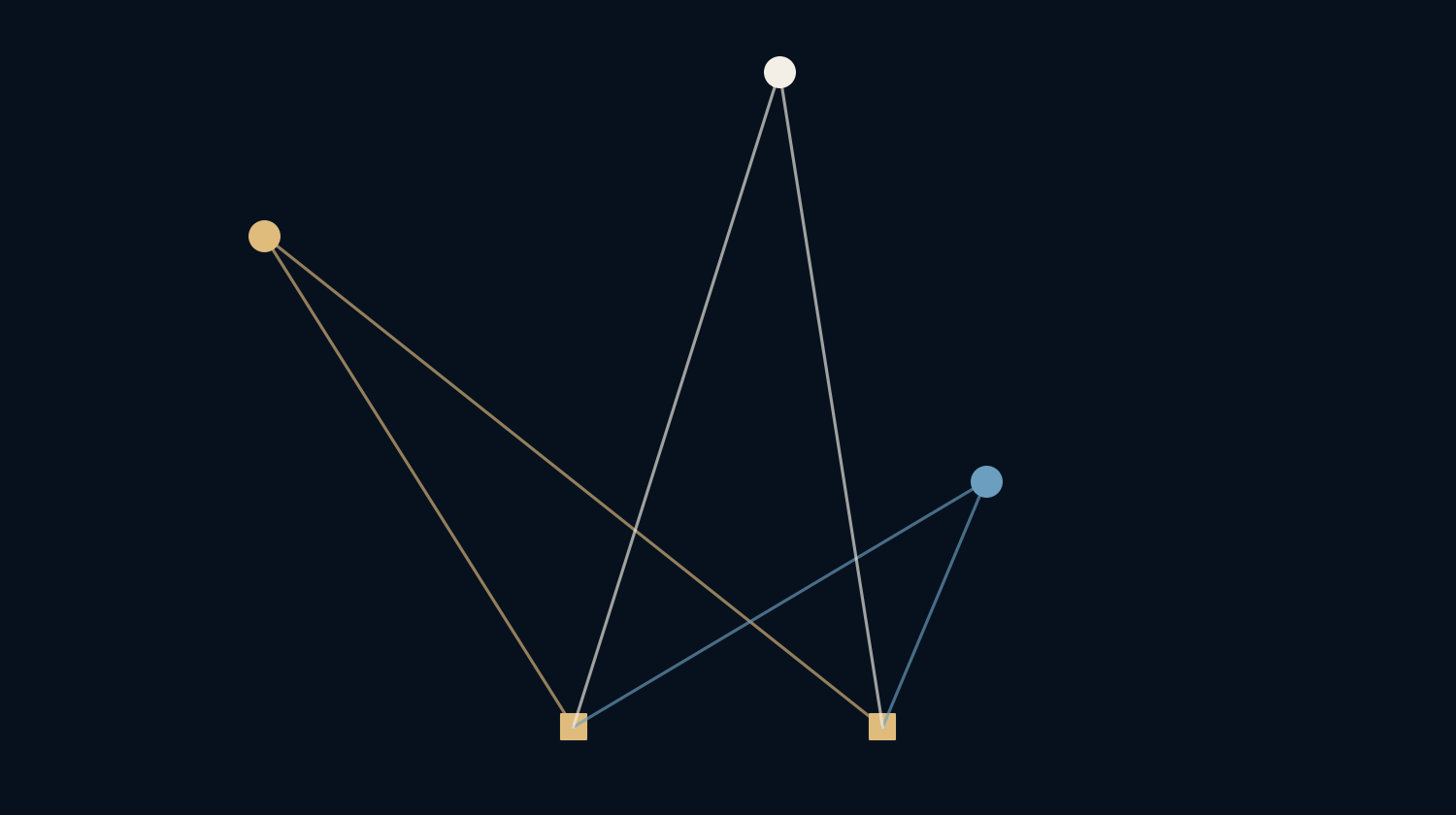
Why does a nearby finger jump when you alternate eyes?
Each eye sees the world from a slightly different position. Nearby objects change position against the background more than distant ones. Stereo cameras exploit a related geometric clue: the displacement of a matched scene point between two images. It is a useful distance signal, but only after several assumptions have been made explicit.
Distance hides in the disagreement between two views.
Start with a pair that agrees on everything else
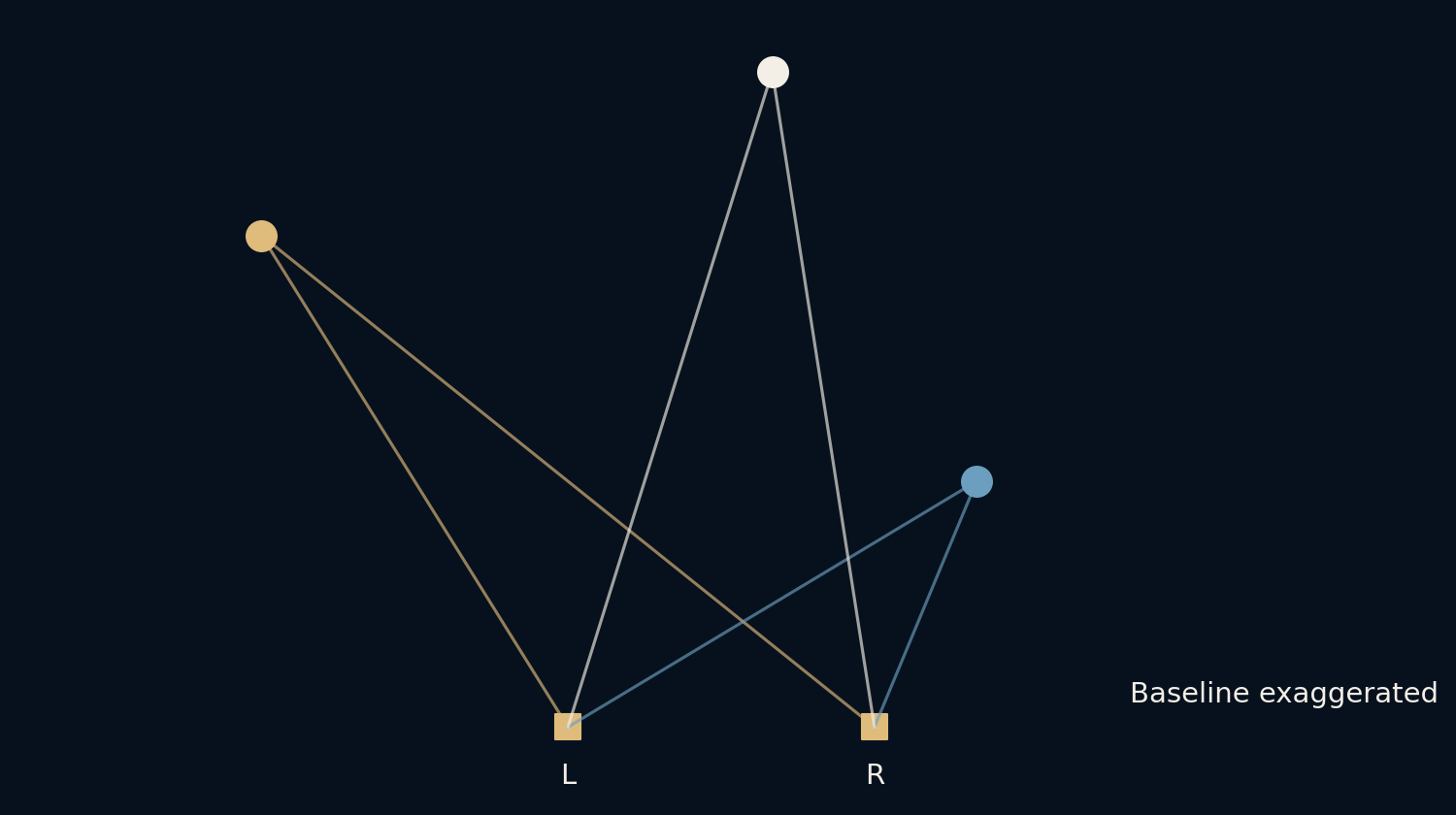
Our model uses two ideal pinhole cameras with parallel viewing directions and aligned image planes. Their centers are separated horizontally by 0.06 meter. Each has a focal length of 800 pixels. Expressing focal length in pixels connects the geometry to image coordinates; it is not the same quantity as a lens focal length quoted in millimeters.
A scene point appears at different horizontal positions in the two views. After alignment, their coordinate difference is called disparity. Real stereo pipelines usually calibrate cameras and rectify images to approximate this convenient arrangement. The simplicity of our drawing comes from assuming those steps have already succeeded.
The triangle gives a compact rule
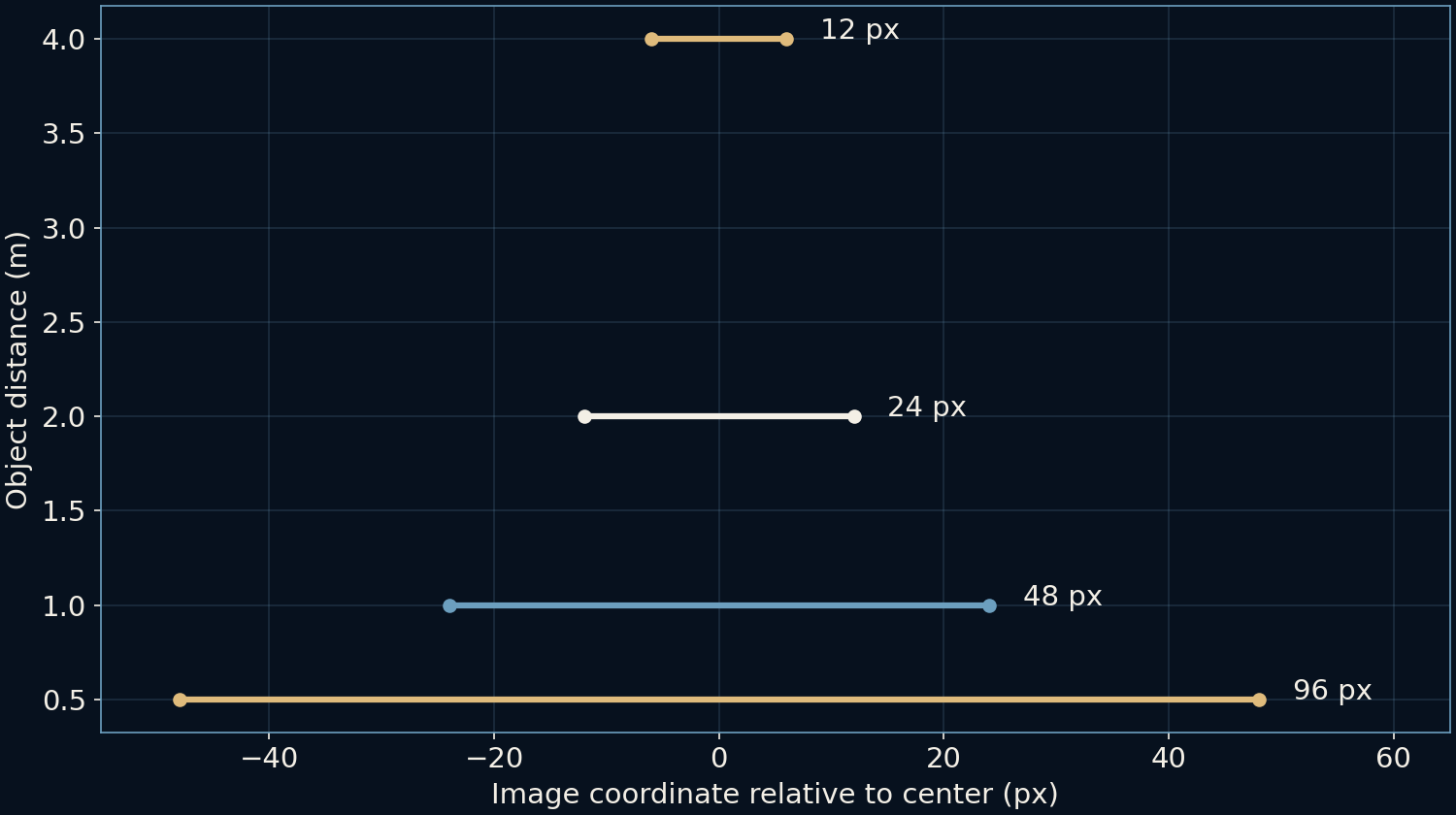
For this arrangement, disparity equals focal length times baseline divided by depth. With our choices, the numerator is 48 pixel-meters. A point one meter away therefore has 48 pixels of disparity. At two meters it has 24, and at four meters it has 12. Doubling distance halves the displacement.
Depth here means distance along the camera’s viewing axis, not the full slanted distance from a camera center to the point. Keeping that distinction prevents a small but important ambiguity. The illustrated camera spacing is exaggerated for readability; the numerical calculations use the stated six-centimeter baseline throughout.
Near objects offer a larger signal
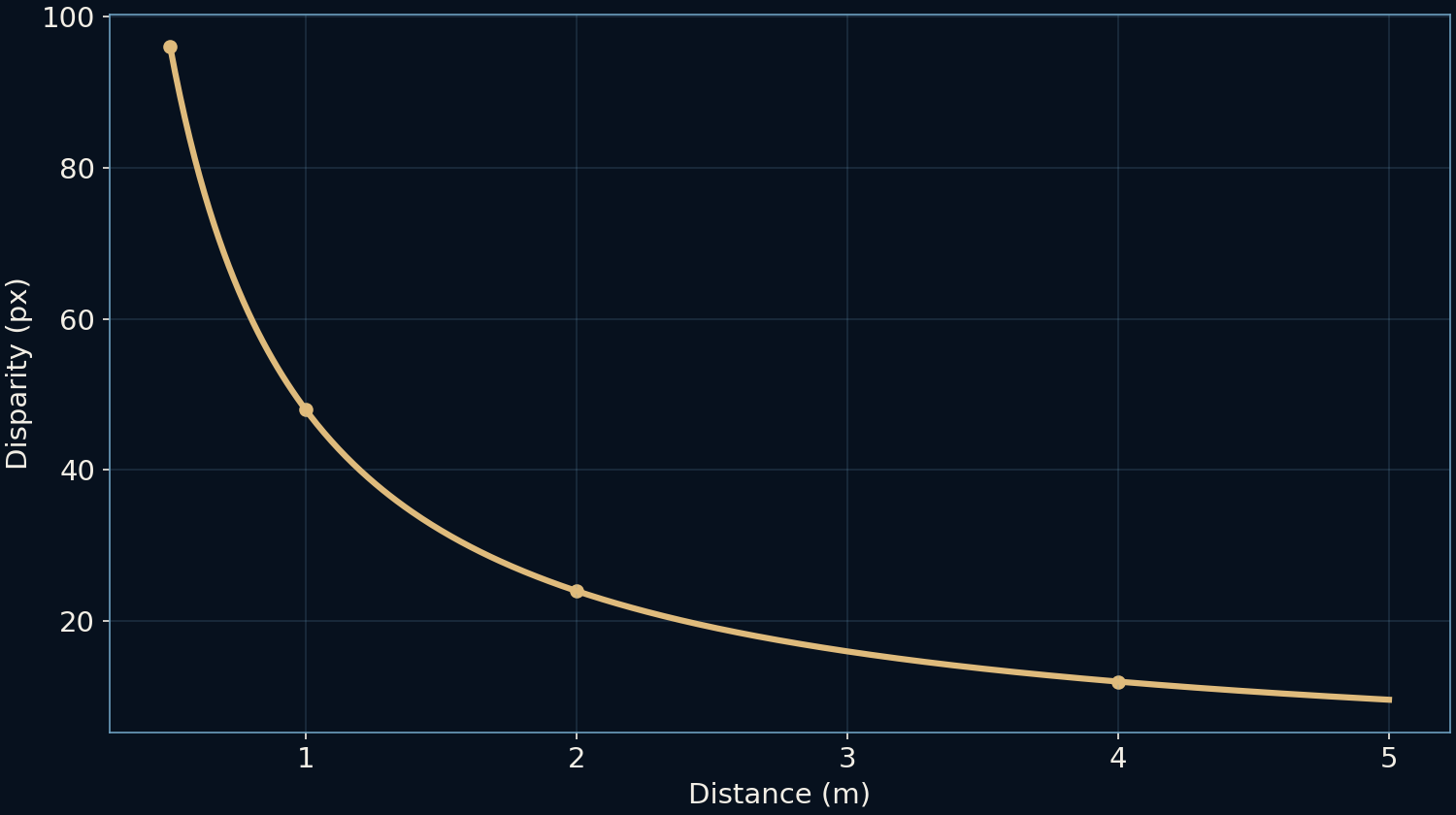
The plotted examples include a point at half a meter, where disparity reaches 96 pixels. The curve then falls rapidly before flattening with distance. This is why the same image-coordinate uncertainty can translate into very different depth uncertainty depending on where the object sits.
At the four-meter example, changing the measured disparity from 12 pixels to 11 changes the inferred depth to about 4.36 meters. Changing it to 13 gives about 3.69 meters. These are deterministic consequences of the inverse formula, not measured error bars for a camera. The asymmetry comes from division, not random noise.
Matching is the difficult verb
The formula assumes the same physical point has been identified in both pictures. Repeating wallpaper, blank walls, reflections and transparent surfaces can make that identification ambiguous. A feature visible in one view may be hidden in the other. Such occlusions cannot be fixed merely by applying the equation more precisely.
Real systems use neighborhoods, consistency checks and other information to decide which matches are credible. A colorful depth map can conceal this uncertainty if every pixel is presented with equal confidence. Our synthetic points have known identities, so the demonstration isolates geometry and does not measure the reliability of an actual matching algorithm.
A wider baseline is a trade
Increasing camera separation increases disparity for the same depth and focal length. That can make distant differences easier to measure. It also makes the views less alike, changes overlap and can expose more occlusions. There is no baseline that is best for every scene and working distance.
Focal length has a similar relationship in the simplified equation, but changing optics also changes field of view and practical image formation. Resolution, calibration accuracy and distortion matter. The graph is therefore a way to reason about a design choice, not a shortcut from one specification to an overall depth-quality rating.
The brain has more than one clue
Human depth perception also uses perspective, motion, shading, occlusion and familiar size. Stereo disparity is one contributor, and its usefulness depends on the scene and the observer. The two-camera calculation should not be mistaken for a complete model of vision or a diagnostic test of anyone’s eyesight.
What transfers well is the habit of asking where a distance estimate came from. Was a correspondence actually supported? Was the geometry calibrated? How much image displacement was available? Two images can contain a powerful depth clue, but the number becomes trustworthy only when the path from pixels to geometry remains visible.
Further reading
OpenCV: camera calibration and 3D reconstruction ↗OpenCV: depth from stereo ↗Original documentation and useful background.