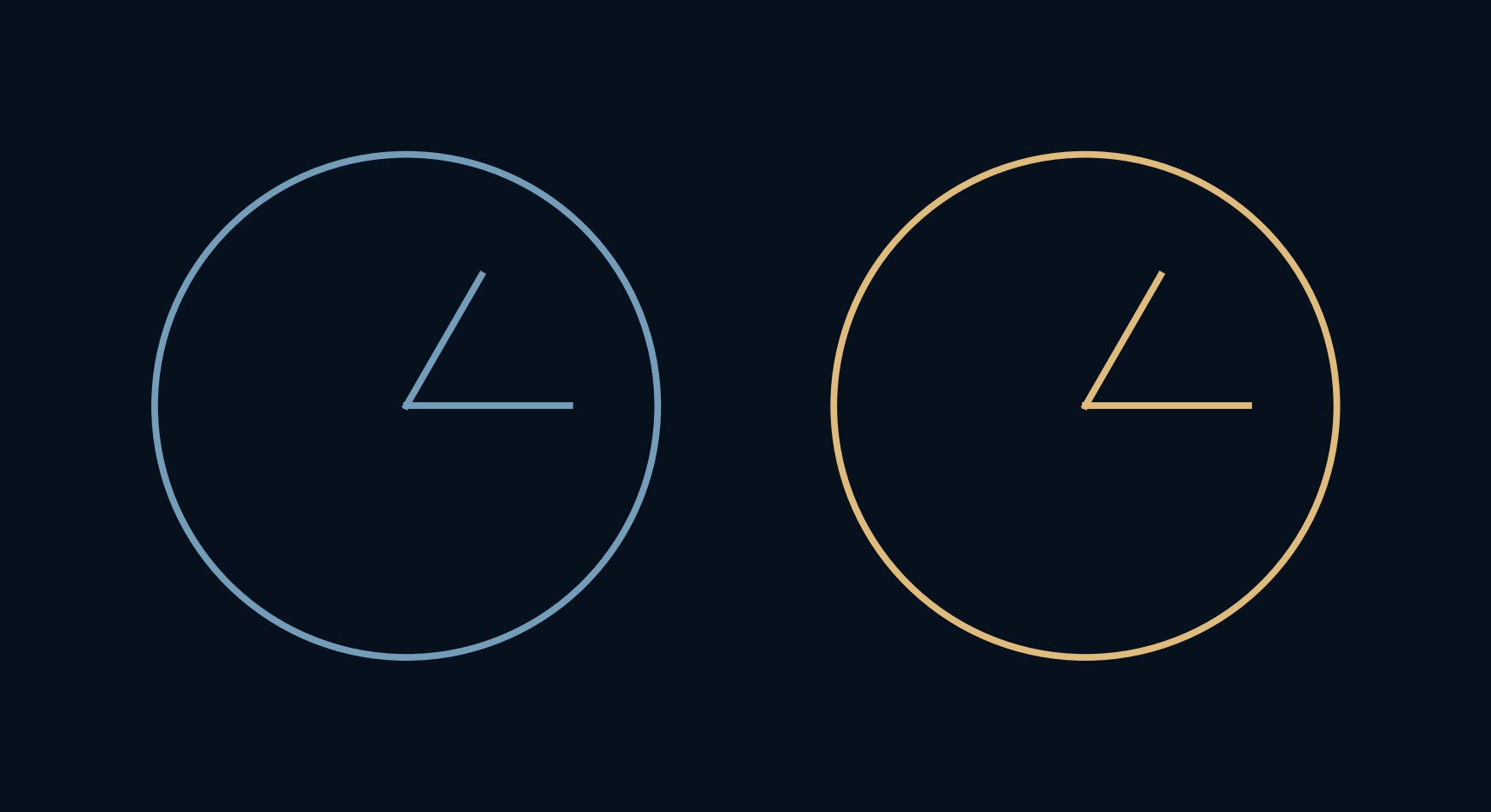
In New York, 01:30 happened twice on one autumn morning.
This is a historical fixture, not a live meeting or a prediction about future clock policy. Using the installed time-zone database, the script examines November 3, 2024 in America/New_York. Two valid local date-times both say 01:30. One corresponds to 05:30 UTC; the other corresponds to 06:30 UTC. A one-hour difference is hidden behind an identical clock face.
A local time needs enough context to identify a moment.
The label is only part of the address
A local date and clock time describe how a community labels a moment. UTC gives a common reference for comparing instants across locations. The offset tells us how to translate between that reference and a particular local representation. During the repeated hour in this example, the applicable offset changes even though the clock labels repeat.
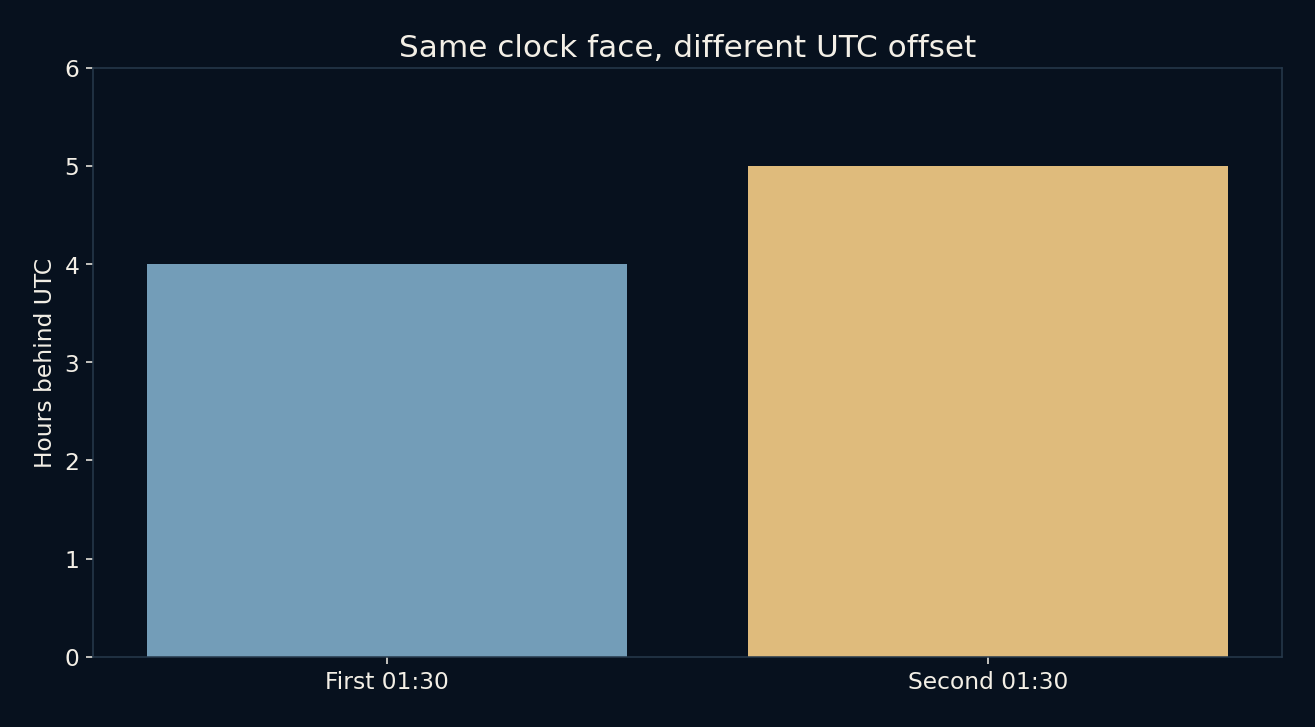
The first 01:30 has offset UTC−04:00 and the second has UTC−05:00. Written with their offsets, the two timestamps are no longer identical. Both are legitimate representations under the installed historical rules. Keeping only the text “01:30” would discard the information needed to choose between them.
One extra bit resolves this ambiguity
Python’s zoneinfo works with the datetime fold attribute to distinguish repeated local times. The fixture creates 01:30 with fold=0, then the same local fields with fold=1. In this transition, those select the earlier and later occurrences. Converting each to UTC produces 05:30 and 06:30 respectively.
The script then converts both UTC instants back to New York. Each returns the same local hour and minute, but the fold values remain different. This round trip is useful evidence that the two values really refer to separate instants, rather than merely two ways of formatting the same time.
Elapsed time belongs on a consistent timeline
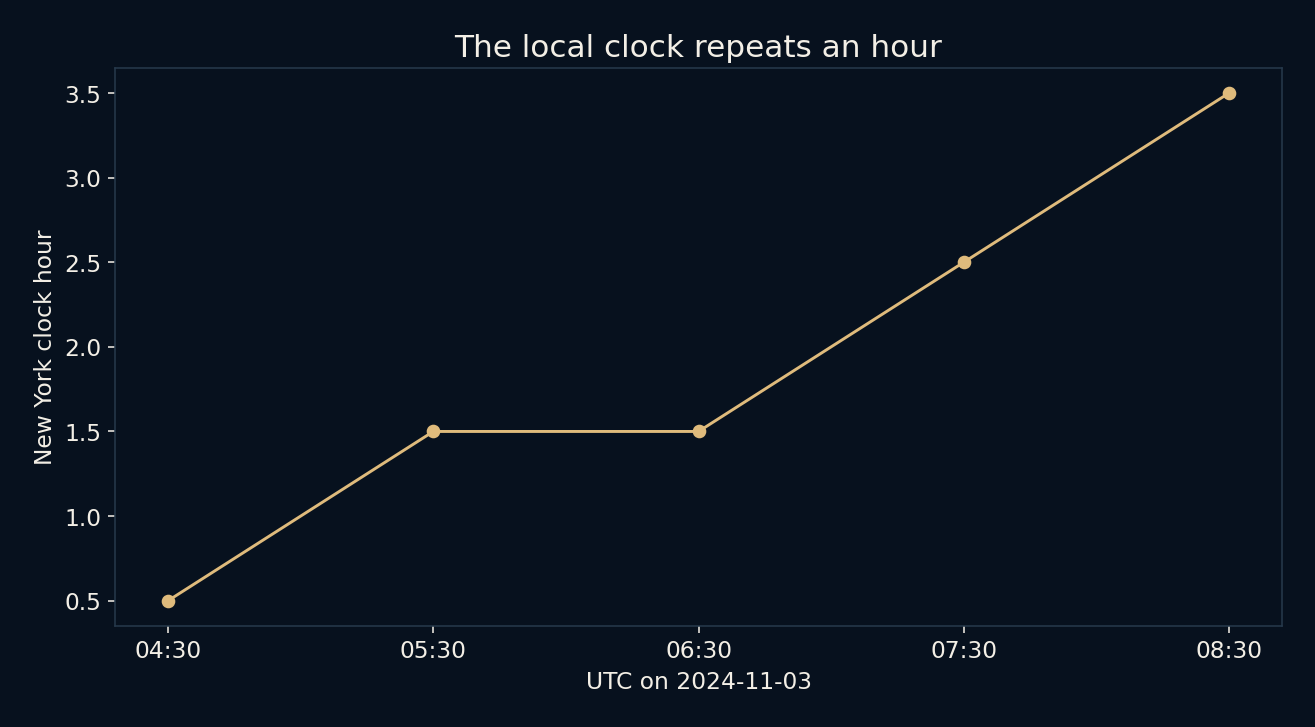
Subtracting the two UTC instants gives 3,600 seconds. That is the elapsed separation this article reports. A local wall-clock label alone cannot reveal it. The timeline figure samples the clock at selected UTC instants; its connecting line is a visual guide, not a claim that the local clock stood still between the two 01:30 labels.
Calendar arithmetic and elapsed-time arithmetic answer different questions. “The same local time tomorrow” need not mean “exactly twenty-four hours later” across an offset transition. A recurring local appointment and a fixed-duration timer therefore need different rules. The experiment does not create either, but the distinction explains why software needs more than a bare hour field.
An offset is not a time zone
The fixed offset −04:00 describes one translation to UTC. The zone name America/New_York refers to a set of historical and projected civil-time rules. Those concepts are related but not interchangeable. Reusing a single offset for every date would erase the transition that makes this example interesting.
Civil-time rules are maintained as data because authorities can change them. The installed database identifies itself as version 2026b, and this article uses it only to evaluate the specified historical fixture. That version label is provenance for the calculation, not a guarantee that future appointments will remain correct without updated rules.
Good questions prevent quiet guesses
When a local time is ambiguous, a system should have a defined way to select or request the intended occurrence. Spring-forward transitions introduce a different issue: some local labels do not occur at all. That case is not tested here, and choosing a policy for it should not be disguised as an automatic mathematical answer.
For recorded events, preserving an unambiguous instant together with useful local context makes later interpretation easier. For future local schedules, retaining the named zone and the intended wall-clock rule matters. There is no universal storage recipe for every calendar task, but there is a reliable warning sign: if removing a field makes two different moments look identical, the missing field may be essential.
Further reading
Python: zoneinfo and ambiguous times ↗Python PEP 495: local time disambiguation ↗IANA: time-zone database ↗Original documentation and useful background.